
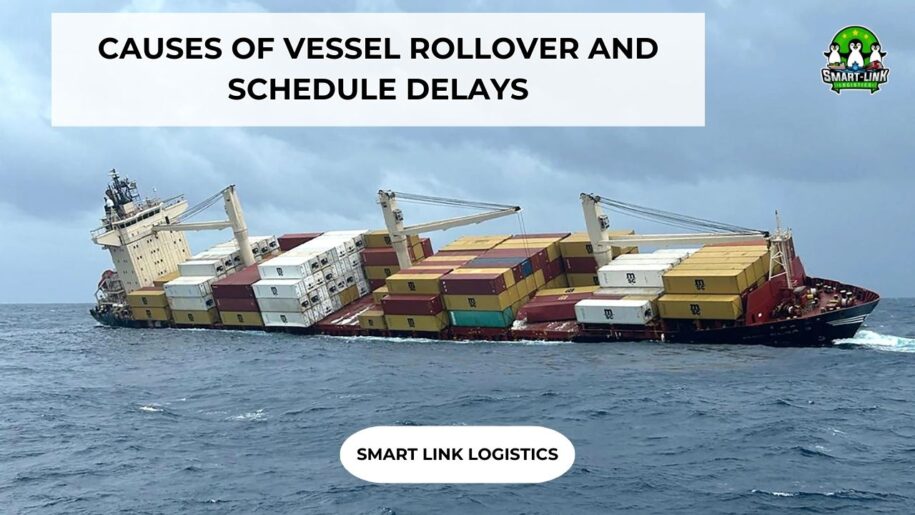
CAUSES OF VESSEL ROLLOVER AND SCHEDULE DELAYS
Vessel rollover and schedule delays are among the most challenging issues faced by import–export companies and logistics providers. Even a minor disruption to a vessel schedule can trigger a chain reaction of consequences, including late deliveries, additional demurrage and detention (DEM/DET) charges, customer dissatisfaction, and in severe cases, contractual penalties.
In this article, Smart Link Logistics explains what vessel rollovers and delays are, why they occur, and how businesses can respond quickly, effectively, and in compliance with proper procedures.
1. What Are Vessel Rollover and Vessel Delay?
Vessel rollover or vessel delay occurs when a container is not loaded onto the originally scheduled vessel and must wait for a subsequent sailing.
Typically, delays range from 3 to 7 days, but they can be longer during peak seasons.
Consequences of Vessel Rollover or Delay
-
Failure to meet contractual delivery deadlines
-
Disruption to the customer’s production or distribution plans
-
Additional costs such as demurrage, detention, and rebooking fees
-
Risk of order cancellations or termination of future cooperation
To minimize these risks, businesses must clearly understand the root causes of vessel rollovers.
2. Why Do Vessel Rollovers and Delays Occur?
Vessel rollovers and delays can result from various factors, both controllable and uncontrollable.
Adverse Weather Conditions
Storms, tropical depressions, rough seas, and strong winds may force vessels to alter routes, call at additional ports, or even cancel sailings. This is a common cause throughout the year, especially during storm seasons.
Port Congestion
During peak seasons, a high volume of containers can overwhelm port capacity. Slower handling times lead to extended waiting periods and missed vessel schedules.
Transshipment
Many shipments rely on transshipment to reduce costs. When cargo is transferred from a feeder vessel to a main vessel, even a minor delay at one point can disrupt the entire schedule.
Previous Voyage Delays
If a vessel’s earlier voyage is delayed, subsequent sailings are often affected in a domino effect.
Blank Sailings and Overbooking by Shipping Lines
-
Shipping lines may cancel sailings when cargo volume is insufficient.
-
To mitigate cancellations, carriers often accept bookings beyond actual capacity. If fewer customers cancel than expected, late-arriving containers may be rolled to the next vessel.
Missing Cut-Off Deadlines by the Shipper
Common issues include:
-
Late submission of Shipping Instructions (SI) or Verified Gross Mass (VGM)
-
Errors in customs declarations that cannot be corrected in time
-
Failure to deliver containers to the port by the cut-off time
-
Containers dropped at the wrong terminal
-
Unexpected physical inspections that delay cargo release
Force Majeure Events
Maritime accidents, fires, piracy, port handling errors, epidemics, or other unforeseen events can also result in vessel rollovers.
3. Fast and Effective Solutions When Cargo Is Rolled or Delayed
Once a vessel rollover is identified, businesses should act immediately using the following steps:
Identify the Root Cause
If the rollover is caused by the shipping line:
-
The shipper generally has no direct control
-
The carrier will arrange the earliest available alternative sailing
-
Demurrage, detention, and related costs are typically borne by the carrier
If the rollover is caused by the shipper or operations team:
-
Late SI or VGM submission
-
Delayed customs clearance
-
Incorrect terminal drop-off
-
Failure to consolidate cargo on time
In these cases, the shipper is usually responsible for the additional costs incurred.
Notify the Customer Immediately
As soon as the cause is identified:
-
Clearly inform the customer about the rollover or delay
-
Provide the earliest revised sailing schedule
-
Propose responsibilities and corrective actions
Early and transparent communication helps reduce pressure and maintain customer trust.
Arrange the Earliest Possible Replacement Vessel
The forwarder should immediately coordinate with the shipping line to:
-
Confirm the next available sailing
-
Complete all documentation and customs procedures as early as possible
-
Minimize additional costs caused by extended waiting time
In many cases, the costs arising from a vessel rollover can exceed the original freight rate.
4. How to Minimize Vessel Rollovers and Delays
Businesses can proactively reduce the risk of vessel rollovers by implementing the following measures:
Optimize Production and Documentation Processes
-
Complete cargo packing on schedule
-
Submit customs declarations early
-
Prepare inspection, quarantine, fumigation, and related documents in advance
Book Space Early
Booking one to two weeks in advance helps avoid capacity shortages and schedule changes.
Prioritize Direct Services
Direct sailings significantly reduce the risk associated with transshipment, one of the most common causes of delays.
Choose Alternative Transport Modes for Urgent Cargo
-
Road transport
-
Air freight
Although more expensive, these options substantially reduce the risk of delivery delays.
Closely Monitor Cut-Off Deadlines
Carefully track:
-
SI submission deadlines
-
VGM submission deadlines
-
Container gate-in times
-
Customs declaration deadlines
Select a Reliable Forwarder
An experienced forwarder will:
-
Proactively handle unexpected issues
-
Negotiate more effectively with carriers when cargo is at risk of being rolled
-
Provide accurate scheduling advice and risk assessments
Conclusion
Vessel rollovers and delays are common risks in international shipping, but they can be effectively minimized through proper planning, close schedule monitoring, and cooperation with reputable logistics partners. Understanding the causes and appropriate response strategies not only reduces financial losses but also helps maintain delivery performance and business credibility.
If you’re looking for the best import-export solutions, feel free to contact us for detailed consultation. If you need legal support or assistance with customs procedures in import-export activities, please contact Smart Link Logistics for fast and efficient consultation. With over 15 years of experience in the transportation field, we are proud to accompany you throughout your journey.
Hotline: + 84 902 964 982 to know more about our services

If you require assistance with international import and export of goods, please contact our team at Smartlink Logistics. We are available to provide you with professional guidance on our services and the necessary customs procedures.
SMART LINK: BEST SERVICE BEST YOU
 SMART LINK LOGISTICS
  215-217 Tran Hung Dao, Co Giang Ward, Dist 1, Hochiminh, Vietnam
 Hai Phong Branch Da Nang Branch Ha Noi Branch
 Air Freight,
  Sea Freight,
  Custom Clearance,
  Warehouse,
  Trucking
  For sea freight, airfreight, express, customs….