
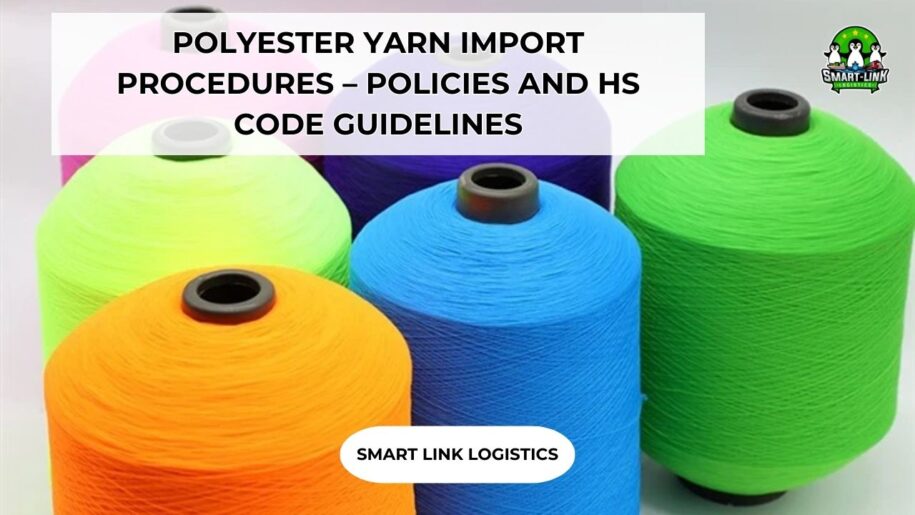
POLYESTER YARN IMPORT PROCEDURES – POLICIES AND HS CODE GUIDELINES
Polyester yarn is a key raw material used in various industries, including textiles and garments, furniture, automotive manufacturing, and light industrial production. As demand for polyester yarn imports into Vietnam continues to rise, businesses must clearly understand the applicable regulations, HS codes, tax rates, and customs procedures in order to avoid potential risks and unexpected costs.
In this article, we provide a comprehensive guide to polyester yarn import procedures, enabling enterprises to proactively prepare documentation, optimize costs, and ensure smooth customs clearance.
1. Import Policies for Polyester Yarn in Vietnam
The import procedures for polyester yarn are governed by several legal documents, including:
-
Circular 38/2015/TT-BTC and Circular 39/2018/TT-BTC (amendments and supplements)
-
Decree 69/2018/ND-CP
-
Decision 18/2019/QD-TTg
-
Circular 21/2017/TT-BCT
-
Decree 43/2017/ND-CP on goods labeling
-
Decree 128/2020/ND-CP on penalties for customs violations
Under current regulations, polyester yarn is not included in the list of prohibited imports. However, businesses must note the following:
-
Mandatory goods labeling in accordance with Decree 43/2017/ND-CP
-
Accurate determination of the HS code to apply the correct tax rate and avoid penalties
A thorough understanding of import policies forms the foundation for successfully managing the entire customs clearance process.
2. Labeling Requirements for Imported Polyester Yarn
2.1 Mandatory Label Information
Labels for imported polyester yarn must clearly display the following basic information:
-
Name and address of the exporter
-
Name and address of the importer
-
Product name and description
-
Country of origin
During customs clearance, particularly in cases of red-channel inspection, customs authorities carefully review labeling compliance. Incomplete or inaccurate labeling may result in cargo being held for violation handling.
2.2 Label Placement
Labels must be affixed in visible locations, such as:
-
On cartons
-
On wooden pallets or crates
-
Directly on product packaging
For retail goods, labels must clearly state the manufacturer, weight, technical specifications, and other required information.
2.3 Risks of Non-Compliance
Failure to comply with labeling regulations may result in:
-
Administrative penalties under Decree 128/2020/ND-CP
-
Denial of preferential import tax treatment if the Certificate of Origin is rejected
-
Increased risk of cargo damage during transportation due to lack of proper warnings
3. HS Code and Import Duties for Polyester Yarn
3.1 HS Code Classification
The HS code serves as the basis for determining applicable tax rates and specialized management policies. Polyester yarn generally falls under Chapter 54 of the Import–Export Tariff Schedule. Depending on its characteristics, specifications, and level of processing, the HS code may vary.
Businesses must consider:
-
Whether the yarn is filament yarn or spun yarn
-
Whether it is packaged for retail sale
-
Fineness and twist level
-
Processing status
Incorrect HS code classification may lead to customs delays, tax reassessment, and administrative penalties.
3.2 Risks of Incorrect HS Code Declaration
Misdeclaration of the HS code can cause serious consequences, including:
-
Extended customs clearance time
-
Penalties under Decree 128/2020/ND-CP
-
Additional storage and demurrage costs
-
Retroactive tax collection and late payment penalties
In some cases, penalties may amount to several times the payable tax.
3.3 Applicable Import Taxes
The following taxes apply to polyester yarn imports:
-
Value Added Tax (VAT): 10%
-
Preferential import duty: approximately 3%–12%, depending on the HS code
Additionally, under Decision 2302/QD-BCT dated October 13, 2021, certain polyester yarn products imported from India, Malaysia, Indonesia, and China may be subject to anti-dumping duties.
3.4 Import Duty Calculation
The formula for calculating import duty is:
Import Duty = CIF Value × Import Duty Rate
The CIF value includes the cost of goods, insurance, and freight to the port of entry.
4. Required Documentation and Import Procedures
4.1 Import Dossier
The import dossier for polyester yarn typically includes:
-
Customs declaration
-
Bill of lading
-
Commercial invoice
-
Sales contract
-
Packing list
-
Product catalog (if applicable)
-
Certificate of Origin (C/O) and other required documents
4.2 Import Process
The standard import process consists of the following steps:
- Step 1: Submit the customs declaration electronically through the system
- Step 2: Register the declaration and submit the dossier at the customs office
- Step 3: Complete customs clearance and fulfill tax obligations
- Step 4: Arrange cargo release and transport goods to the warehouse
Timely and accurate declaration is essential to avoid administrative penalties.
4.3 Common Mistakes
Frequent errors in polyester yarn import procedures include:
-
Incorrect HS code declaration
-
Incomplete documentation
-
Late submission or registration of the customs declaration
5. Important Notes When Importing Polyester Yarn
During the import process, businesses should pay special attention to the following:
-
Used polyester yarn is prohibited from importation
-
The Certificate of Origin directly affects the applicable tax rate
-
All tax obligations must be fulfilled before customs clearance
-
Product labeling must comply with legal requirements
-
HS codes must be accurately determined from the outset
Conclusion
Although polyester yarn import procedures are not overly complex, they require a clear understanding of applicable regulations, HS codes, tax rates, and customs processes. Careful preparation of documentation, accurate declaration, and strict compliance with legal requirements will ensure smooth import operations, minimize risks, and optimize overall costs.
If you’re looking for the best import-export solutions, feel free to contact us for detailed consultation. If you need legal support or assistance with customs procedures in import-export activities, please contact Smart Link Logistics for fast and efficient consultation. With over 15 years of experience in the transportation field, we are proud to accompany you throughout your journey.
Hotline: + 84 902 964 982 to know more about our services

If you require assistance with international import and export of goods, please contact our team at Smartlink Logistics. We are available to provide you with professional guidance on our services and the necessary customs procedures.
SMART LINK: BEST SERVICE BEST YOU
 SMART LINK LOGISTICS
  215-217 Tran Hung Dao, Co Giang Ward, Dist 1, Hochiminh, Vietnam
 Hai Phong Branch Da Nang Branch Ha Noi Branch
 Air Freight,
  Sea Freight,
  Custom Clearance,
  Warehouse,
  Trucking
  For sea freight, airfreight, express, customs….