
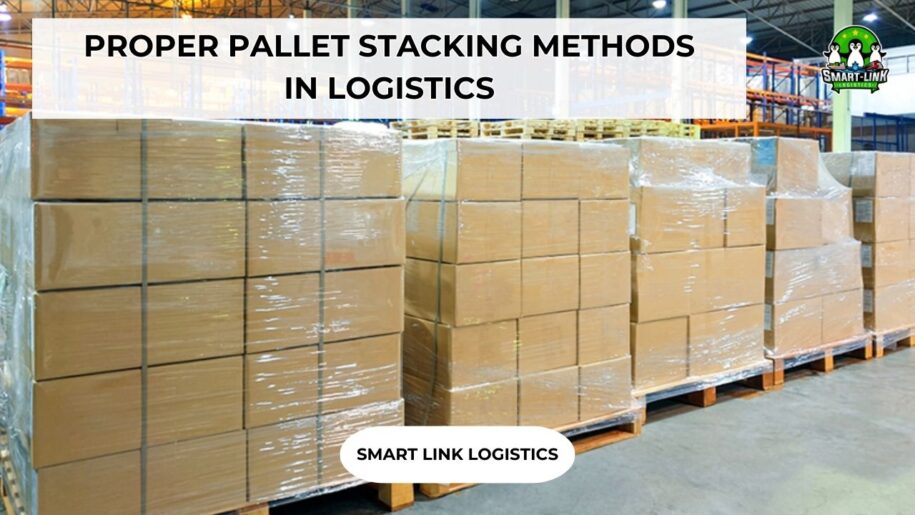
PROPER PALLET STACKING METHODS IN LOGISTICS

In the logistics and import-export supply chain, pallet stacking is a fundamental step that is often underestimated. Many businesses focus primarily on transportation, freight costs, or documentation, while overlooking the fact that improper pallet stacking can lead to cargo damage, additional expenses, and even delivery delays.

In reality, numerous incidents such as tilted pallets, dented goods, collapsed cartons, or shipments being rejected at CFS warehouses or seaports originate from incorrect pallet stacking techniques. Therefore, understanding and applying proper pallet stacking methods not only helps protect goods but also optimizes costs and minimizes risks throughout the transportation process.


1. Avoid Stacking in a “Pyramid” Shape

One of the most common mistakes in pallet stacking is arranging smaller cartons on top of larger ones, forming a pyramid-like structure.

This method creates serious imbalance because the weight is not evenly distributed across the pallet surface. When the pallet is lifted by a forklift, transported over long distances, or subjected to vibration inside a container, the risk of tilting or collapse becomes very high. Moreover, many warehouses and shipping terminals refuse to accept pallets with uneven top surfaces due to safety concerns.

The correct principle is that the top surface of the pallet must be flat and stable. Cargo layers should be stacked evenly and squarely to ensure that weight is distributed uniformly across the entire pallet.


2. Cargo Must Not Extend Beyond the Pallet

Goods protruding beyond the edges of a pallet is another frequent technical error, especially when businesses try to maximize space usage or rush the packing process.

When cargo extends outside the pallet dimensions, it becomes vulnerable to impact during forklift handling, may be crushed when loaded into containers or trucks, and can be rejected by transit warehouses. In many cases, even a few centimeters of overhang are enough to cause the pallet to fail safety standards.

The safety requirement is that all goods must remain fully within the pallet boundaries, with no overhanging edges or corners. This ensures greater stability and significantly reduces risks during handling and transportation.


3. The Golden Rule: Heavy at the Bottom, Light on Top

Proper weight distribution is a critical factor in pallet stacking. A basic yet essential rule is to place heavier items at the bottom and lighter ones on top.

Heavier goods at the base create a solid foundation for the entire pallet, while lighter goods on top reduce pressure on the lower layers. This method helps prevent crushed cartons, torn packaging, or pallet deformation.

A common mistake is stacking goods in the order they are packed or based on convenience rather than considering individual package weight, which can result in unstable pallets and potential accidents during movement.


4. Apply the “Brick Stacking” Technique for Greater Stability

Brick stacking is a method in which cartons are arranged in alternating patterns, similar to the way bricks are laid in a wall. This technique is widely recommended in export logistics.

The advantage of this method is that it increases the interlocking connection between cartons, minimizes gaps, and prevents movement when containers experience vibration, sudden braking, or rough sea conditions. Brick stacking is particularly suitable for carton boxes, bagged goods, FMCG products, and large export shipments.


5. Secure Pallets Properly, Not Just for Appearance

Pallet securing is the step most commonly done incorrectly or performed superficially. Inadequate wrapping, using too few layers of stretch film, or applying insufficient strapping can cause pallets to loosen and shift during transit.

The correct solution is to use PE stretch film with sufficient layers, combined with plastic or steel straps to firmly secure the load. The wrapping and strapping should be applied from the base of the pallet up to the top of the cargo, ensuring that the pallet can be lifted, moved, or slightly tilted without any movement of the goods.


6. Control Pallet Height for Safety and Cost Efficiency

Many people assume that stacking pallets as high as possible will reduce transportation costs. However, in reality, excessively high pallets are more prone to instability, increase the risk of collapse during handling, and may not fit the height limits of containers or trucks.

Pallet height should comply with the limits of forklifts, warehouse requirements, and the type of container being used, such as 20-foot, 40-foot, or high-cube containers. In logistics, ensuring stability and safety is always more important than attempting to maximize space at all costs.


The Importance of Proper Pallet Stacking in Export Logistics

Experience in the logistics industry shows that many cargo losses do not occur during transportation itself but originate from improper pallet stacking practices. Just one incorrectly stacked pallet can result in damage to an entire shipment, additional handling costs at ports or warehouses, disputes over liability, and delays in delivery schedules.

Therefore, proper pallet stacking is not merely a technical requirement but a strategic factor that helps businesses control risks, optimize costs, and enhance their credibility in logistics and import-export operations. If you’re looking for the best import-export solutions, feel free to contact us for detailed consultation. If you need legal support or assistance with customs procedures in import-export activities, please contact Smart Link Logistics for fast and efficient consultation. With over 15 years of experience in the transportation field, we are proud to accompany you throughout your journey.

Hotline: + 84 902 964 982 to know more about our services

If you require assistance with international import and export of goods, please contact our team at Smartlink Logistics. We are available to provide you with professional guidance on our services and the necessary customs procedures.

SMART LINK: BEST SERVICE BEST YOU

? SMART LINK LOGISTICS ?
?215-217 Tran Hung Dao, Co Giang Ward, Dist 1, Hochiminh, Vietnam
? Hai Phong Branch ? Da Nang Branch ? Ha Noi Branch
✈️ Air Freight, ? Sea Freight, ? Custom Clearance, ? Warehouse, ?Trucking
Hotline: +84902964982
Email: marketing03@smartlinklogistics.com.vn
Member: BNI, VCCI, VLA
———
✈️ ? For sea freight, airfreight, express, customs….
Smart Link Logistics could bring your cargo to the world.
Pro Vietnamese customs, Door To Door, FaceMask, Glove, Smart Link Logistics, Ocean Freight, Air Freight, Express, Amazon, Heart Service
#haiquan #xuatnhapkhau #duongbien #smartlinklogistics #cuocvantaiquocte #logistics #thongquan
partnerpartnerpartnerpartnerpartnerpartnerpartnerpartnerpartnerpartnerpartnerpartnerpartnerpartnerpartnerpartnerpartnerpartnerpartnerpartnerpartnerpartnerpartnerpartnerpartnerpartnerpartnerpartner